11 Tips Learned in 25 years of Daily Carry

I started carrying a gun daily when I was around 25 years old. Before that, I typically kept a gun in the truck. Usually, it was more than one, but I seldom carried one on my person. I was, in fact, completely oblivious of a daily carry regimen; I just knew I could get to my gun if needed. Luckily, I never had to find out.
When I stepped into the position of sheep dog, I went all the way. I researched methods of carrying, holsters, handguns, calibers and training. I studied the tactics of experts dating back to long before I was born. This included books and articles by some of the legends, such as Jeff Cooper and Bill Jordan, among many others. I even took gun training classes to gauge and improve my skills.
I learned a lot by reading and implementing some of their tactics into my personal training and daily carry. However, every so often I would see something that just didn’t really make sense, at least to me. Most of the time, it didn’t really apply to my situation. As such, I didn’t really worry about the issue, but it stayed in the back of the mind.
All this, of course, was before I entered the gun writing world, where I got to meet some of the people who guided me in my early days. I actually got to spend a day talking and shooting with Walter Rauch before he died. I am still impressed with most, others less so.
Some of my early heroes no longer practiced what they preached, despite being true believers. Their only sin, however, was reaching the age where comfort mattered above all else. They carry daily, but the handgun/holster combination might not be what they touted for years. All I can really say now is that after 25 years of daily carry, I completely understand the need for comfort.
Real World Daily Carry
Most experts recommend carrying a 9mm or larger caliber handgun in a strong-side holster. For years, they claimed .45 ACP was best for those who could handle the round. Because of this I carried a Kimber Ultra Carry in a Milt Sparks Versa Max 2 as a primary for most of my carry life. This setup has worked well. However, I’m currently carrying a Ruger RXM in a Galco KingTuk Air Cloud IWB.
There have been some situations, however, because of type of work or location, where strong-side wasn’t ideal. Hard physical labor with excessive bending and twisting is uncomfortable and revealing. Sitting in a car limits access to a strong-side gun, particularly in a quick manner.
What’s worse, these deficiencies usually aren’t noticeable until you’re right in the middle of them. In any case, I noticed the “access in a car” dilemma when driving through a not-so-nice-neighborhood in Columbus, Ohio. It wasn’t that I needed the gun; I just wanted access because of what I could see along the narrow streets. In simple terms, I’m not a fan of bucket seats when driving. I can get to my gun on a bench seat in a truck, but those wrap-around seats make it real difficult.
These are some of the issues that made me start looking harder at the accepted norms of daily carry. And I’m not saying any of them are wrong; I’m just saying that they are not always right for every situation. Making the decision to be responsible for your own safety means thinking for yourself, outside of the sheep mindset.
Just because some expert makes a claim doesn’t automatically make it gospel. It is right for him or her; it might not be right for you or me. Or it might be right for us in certain situations, but not others. Self-defense advice is simply that, advice; these are not rules that daily carriers are required to follow.
They are recommendations discovered over years of shooting, training and daily carry that work for that specific person. What I have learned works best for me. This doesn’t mean that it all will work for you. And strategies can even change over the years, just the same as styles and people. Here are some of the things I have learns in 25 years of daily carry.
Have the Means
Carry a gun, any gun, everywhere it is legal. Even a small, low-powered handgun with just a few rounds is better than nothing. You won’t have gun if you only carry it when you think you might need it.
Defensive Mindset
Self-defense is more than having a gun and knowing how to shoot. It is an all-encompassing commitment that says you won’t be a victim. Nor will you stand idle against evil and do nothing.
Most Important Tool
A gun is a tool. It is an important tool, but it is not the most important. The most important tool is the mind. That daily carry gun is useless, or worse, if you don’t have the mindset to use it properly. Drawing and firing in a situation is not always the best choice. Use your head. Avoidance is the best self-defense technique, and that takes the mind.
It Affects Everything
Having a daily carry gun can change everything in your life, from how you dress to where you can legally go. Most states have no-go zones for guns. It can actually affect friendships, as a friend or friend’s spouse might have different views on daily carry. It can even affect how you look at the world, especially as you develop a defensive mindset. When you pay attention, you will notice more.
Comfort Matters & Is Expensive
If your rig, gun and holster, isn’t comfortable, you might not carry it all of the time. Most cheap holsters are not comfortable. Of course, you might have to try two or three before finding the one that works best. What’s comfortable for one person might not be for another. I’ve got some good holsters, but I’m still looking for my perfect holster. It is an expensive journey.
Have Multiple Setups
Figure out a couple of methods to carry. Despite what many claim, the same gun, same holster, same place does not always work in the real world. Clothing requirements for events, work or weather, might limit options and require changes in daily carry routine.
Train for Every Setup
If using multiple setups, train with multiple setups. Training on strong side isn’t good for days when the gun is on the ankle. Train in every way in which you carry a gun, and train often. Think of scenarios to push your skills and your most important tool. Even dry-fire training is better than none.
Most People Notice Nothing
Lots of folks worry about “printing” or revealing guns. It is not a big deal. The average person doesn’t even notice a person walking a few feet away. They’re not going to notice the bulge of a pistol grip, particularly with their faces in their devices. You’ll notice this more as awareness increases.
Grain of Salt
Look at “expert” advice with a critical eye. Take what works and dump the rest. This means, however, that you need to test tactics and advice out at the range. Take their advice and adjust it for yourself.
Get Training
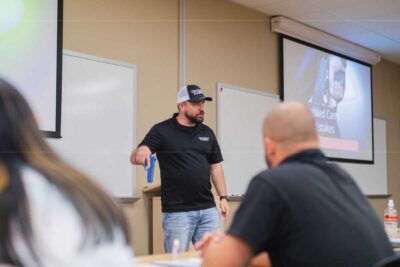
Find a reputable instructor or firearms training school and take classes. There is a difference between learning to shoot and learning to defend with a gun. A good class goes beyond drawing, shooting and firearm manipulation. It starts the road to a defensive mindset. I had been shooting and training for years when I went to Gunsite. The instructors taught me a new way to think.
Train Continuously
Once learning the defensive mindset, keep learning and training. Read articles, watch videos, take additional classes and practice skills at the range. The road to becoming a sheepdog never ends.
These are some of the tips I’ve learned over the years. Yours might be different. Take what works for you and dump the rest.
By Paul Rackley, GunBroker Editor





![Features of the New KelTec PR-5.7™ Compact Concealed Carry [Video]](https://qacontent.gunbroker.com/wp-content/uploads/2025/02/Keltec-PR57-featured-400x267.jpg)
![The Transformed LTT PX4 GSD and PX4 Compact [Video]](https://qacontent.gunbroker.com/wp-content/uploads/2025/03/PX4_PX4-COMPACT-1200-X-800-400x267.png)
![Ruger RXM Handgun: A New Era of Precision and Performance [Video]](https://qacontent.gunbroker.com/wp-content/uploads/2025/04/Ruger_RXM-2-1200-x-800-400x267.jpg)