Skill Series: Running the Backup Drill
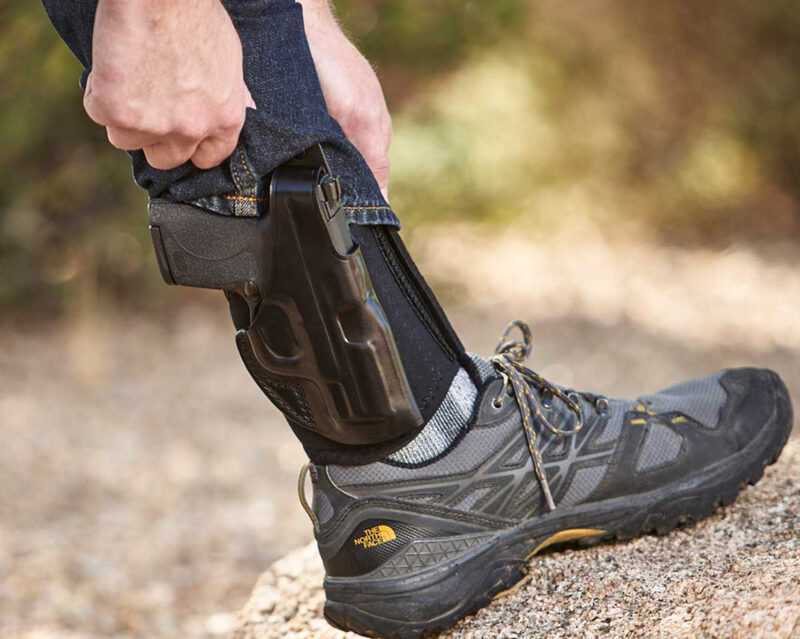
There are a lot of people who like to carry backup guns, me included. I often drop a Ruger LCP with a pocket holster in my boot. This is in addition to my primary, currently a Ruger RXM in a Galco KingTuk Air Cloud IWB. If I’m wearing shoes, instead of cowboy boots, I like my Smith & Wesson 637 in an ankle holster. This rig sometimes becomes primary when I have to wear one of the suits the dry cleaner shrunk.
I like having a backup gun, especially when out with the family. To start, it provides additional rounds in an extreme situation. I’m carrying 31 rounds for my primary in two magazines, which should be enough, but I want extra in case Murphy, with his dang law, interferes. I also like having the option of hiding my family in a safe space with means for defense, if a situation arises. I’m willing to risk my life, not theirs.
There are other ways, of course, to carry a backup gun. Some other popular methods include pocket and bellyband, but folks can carry in any way that is comfortable and accessible. If, however, folks are going to carry a backup, they need to know how to transition from primary to backup. This means training on the Backup Drill.
The Backup Drill
Simple in concept, the Backup Drill is a bit harder in practice. The idea is that if the primary handgun goes down in the middle of a fight, shooters have the means to continue fighting. The reason doesn’t matter, stoppage, malfunction or even running out of ammo. If the main gun doesn’t go bang, you go for the backup.
While this drill can be performed anywhere without ammunition, it is best in a live fire scenario, if possible. It starts by dropping the primary. Those who don’t want to drop a handgun on the ground can use a dummy gun.
As soon as the “gun” leaves your hand, reach for the backup, draw and fire. This can be timed or untimed, but a shot timer can show improvement, or decline. In addition, the best training comes from making the training as real as possible.
Realistic Training
I like realistic training; I probably take it too far at times. The Backup Drill, however, seems like one that really benefits from realistic training. No one knows if or when a primary gun will go down. That is the whole point of a backup gun.
Now, the only thing one truly needs to train for backup drills is the backup gun. Since I like carrying my backup in a boot or on the ankle. All I have to do is train to get it out and into action. That is the basics of this drill. However, that is probably not how it is going to happen in the real world.
I start with my primary and backup guns in their concealed-carry holsters at the range. If I’m alone, I try to randomly load dummy rounds, just like with a malfunction drill, or load varying round counts into magazines. It is best if a partner loads the magazines. Then, I set up a training drill, such as a Bill Drill or a Failure Drill, and run it.
If at any point my primary doesn’t go bang, I transition to my backup. Whether I continue the drill depends on the situation. If facing a single target, it might be better to continue the drill. However, if there is five targets, with rounds in only two, it is probably better to retreat to cover to reassess the situation. If possible, I retreat with the primary in tow, for when I run out of rounds in the backup.
This is an additional benefit of the backup drill; it helps develop a tactical mindset. It is critical for defenders to know how to handle the unpredictible situations of an attack.
Why O’ Why
People carry a backup gun for all kinds of reasons, the first being the idea of “two is one, one is none.” I do it for a few more rounds in case the SHTF. I train with my primary enough to know that if my gun doesn’t fire it is probably a stoppage, a stovepipe or a double feed. It could be a miss fire, but that is very rare with today’s ammunition.
As such, if someone does go wrong, I’m going to perform a stoppage drill to get my primary gun back running. I can probably do that faster than going to my backup. Still, I want that backup gun on my person. It provides an additional means of protection, for myself or others, in what might be a bad situation.


![The Transformed LTT PX4 GSD and PX4 Compact [Video]](https://qacontent.gunbroker.com/wp-content/uploads/2025/03/PX4_PX4-COMPACT-1200-X-800-400x267.png)
![Ruger RXM Handgun: A New Era of Precision and Performance [Video]](https://qacontent.gunbroker.com/wp-content/uploads/2025/04/Ruger_RXM-2-1200-x-800-400x267.jpg)